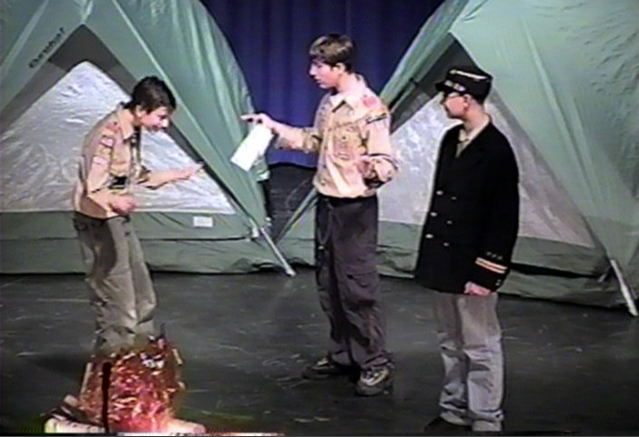
The Melrose Scouting Productions Podcast proudly presents another video from the Boy Scout Troop 68 Laughs For Lunch Show archives. This post features a skit in which a director hires an extra to play a small part in a film. The film is about a legendary ship which hits an iceberg. The extra has only four lines to say but unfortunately cannot get them correct on the first take. The director becomes frustrated, and hilarity follows. Even though this video was recorded in 2001, it holds up very well. The skit would be a great one to perform at any campfire program.

Does your troop have fun performing in front of an audience? Have they ever done this skit? Tell us about it by leaving a comment.

Click here to DOWNLOAD and watch this Podcast
Subscribe to Melrose Scouting Productions Podcast through iTunes.
or at http://feeds2.feedburner.com/melrosescoutingproductions
Check out other Scouting podcasts at PTC Media.

The Citizenship Skill Award was probably the first skill award I earned when I was a Boy Scout in the mid 1970’s. In fact, it was probably the first Boy Scout award I earned since it was required for the rank of Tenderfoot Scout. I went on to earn several of them, along with a few merit badges.

The Citizenship Skill Award requirements were:

1) a. Describe the flag of the United States. Give a short history of it.
b. Explain why you should respect your country’s flag. Tell which special days you should fly it in your state.
c. Using a flag, and with another Scout helping you, show how to hoist and lower the flag, how to hang it vertically and horizontally on a wall, and how to fold it.
d. Tell when to salute the flag and show how to do it.

2) a. Repeat from memory the Pledge of Allegiance. Explain its meaning in your own words. Lead your patrol and troop in the proper ceremony of reciting the pledge.
b. Tell about the meaning of our National Anthem and how it was written.

3) a. Explain the rights and duties of a citizen of the United States.
b. Tell about two things you have done that will help law-enforcement agencies.
c. Explain what a citizen should do to save our resources.

4) Do one of the following:
a. Visit a community leader. Learn about the duties of the job or office. Tell your patrol or troop what you have learned.
b. Learn something about a famous U.S. person of your choosing. Tell your reasons for picking that person and give a short report of what that person did to gain this recognition.
c. Make a list of ten things, places, or sayings, that have some relationship to the history of the United States. Explain their meaning.
d. Know the history and tradition of your state, commonwealth, or territorial flag.

As I was writing these requirements I was flooded with many memories of Boy Scouts completing these requirements over twenty years ago. I also began thinking to myself, this was a great skill award. Some of these requirements have made it into today’s rank requirements, but several of them were lost in the shuffle. This award is one of the reasons I wish the BSA would not have dropped the skill award program.

When I was a Boy Scout in the mid 1970’s we needed to earn belt loops called skill awards for the first three ranks. Each skill award was based on a certain set of skills, such as camping, hiking, or swimming. There were twelve belt loops a Boy Scout could earn. The Citizenship Skill Award and one other were required for Tenderfoot. Hiking, First Aid, and one other skill award were required for Second Class. A Scout needed to complete the Camping, Cooking, and one other skill award for First Class rank, in addition to the First Aid Merit Badge.

When I became a Scoutmaster in 1981 it was easy to use the twelve skill awards as monthly themes for the younger Scouts. Twelve awards, twelve themes. It worked well. Then, in the mid 1980’s, the National Office decided that skill awards would be discontinued and new rank requirements would be created. I hated to see the belt loops dropped from the program, but we had to move on and follow the new “improved” advancement program.

I thought it might be fun to look back at these old awards and what the requirements of each one were at the time. So today, I start with the Camping Skill Award.

1) Present yourself to your leader, properly dressed, before going on an overnight camping trip. Show the camping gear you will use, including shelter and food. Explain how you will use the gear. Show the right way to pack and carry it.

2) Go on two overnight camping trips with your troop, patrol, or other Scouts, using the gear. On each overnight camp, do the following:
a) Carry the gear on your back for at least 2 km to your camp. After camping, carry it 2 km back.
b) Pick a good place for a tent. Pitched a tent correctly in the place you picked and sleep in it overnight. Store the tent correctly after use.
c) Make a bed on the ground. Sleep on it overnight.
d) Follow good health, sanitation, and safety practices. Leave a clean campsite.
e) After each trip, tell your leader what you achieved and learned. Tell how good camping practices proved useful.

3) Whip the ends of a rope. Tie the following knots: square knot, sheet bend, two half hitches, clove hitch, taut line hitch, and bowline. Show their correct use.

4) Lash poles together with the following lashings: square, shear, and diagonal. Show their correct use. Use lashing for making a simple camp gadget.

As you can see, all of these requirements are still a part of the Boy Scout advancement program. They have just been broken up into the first three ranks.
It was a beautiful evening in Melrose on that April day in 1980. A great day to get a few friends together, meet at the city park, and play some ball. I was nineteen years old, almost done with tech college, and was lucky enough to find a fulltime job and a place to rent in my hometown.
We had been playing ball for a little while when I noticed some boys taking down a tent on the other side of the park. “Could that be a Boy Scout group?” I asked myself. There had not been a troop in town for at least 4 or 5 years. I had been a Boy Scout for a few years when I was in my mid teens and enjoyed it. I had thought about joining a troop as an adult leader after finishing college. Maybe this was my chance.

I walked over to the small group packing up the tent and talked to the adult leader, who also happened to be a policeman in town. He admited that he was the scoutmaster of the newly formed troop. In fact, the troop was only a few months old. I asked if he needed any help? He was no idiot so he took me up on my offer. I became an assistant scoutmaster.

Little did I realize that I would still be involved with that troop 30 years later.

During the last 30 years I have seen a lot of boys come and go in Scouting. I have formed strong friendships with some of the boys that have continued into their adult lives. I have gone on many trips with the Scouts, including a National Jamboree and several trips to Philmont Scout Ranch. I have participated in many training sessions, have trained other leaders, and made many friends with other leaders.

I still find it hard to believe that is was three decades ago this month that I became an assistant scoutmaster for Boy Scout Troop 68. I would have not believed anyone if they would have told me that I would stay with the program this long. It has been fun, but there has also been plenty of challenges. Will I be with it for another thirty years? I doubt it, but you never know. Only time will tell.

Scoutmaster Steve and Buttons, the radical Boy Scout, return for this month’s episode of the Around The Scouting Campfire podcast. This episode is dedicated to all Eagle Scouts. Steve and Buttons talk about a recent Eagle court of honor held in Melrose, and play some audio snippets from the ceremony. Steve talks about the scoutmaster conference for the Eagle Rank. Buttons reads a ceremony he would like to include in his Eagle court of honor someday.

Steve and Buttons thank PTC Media (http://www.ptcmedia.net) for allowing this program to be a part of the family of Scouting related podcasts. We also thank the Boy Scout Store (http://boyscoutstore.com) for sponsoring this show. Be sure to take a moment to check out their website. Finally, we would like to thank you, our listeners, for downloading Around The Scouting Campfire.

Send us your emails. We would love to hear from you. You can contact Buttons at buttonst68@yahoo.com. You may contact Scoutmaster Steve at stevejb68@yahoo.com. Please rate the show and/or leave a comment at the iTunes store or at PTC Media forums.
.
Download episode #14 by clicking HERE.
Subscribe to the RSS Feed – http://feeds2.feedburner.com/MelroseScoutingAudioPodcast
This podcast is found on iTunes at
http://itunes.apple.com/WebObjects/MZStore.woa/wa/viewPodcast?id=307979159.

(This is part 2 of an article about the Boy Scouts of Troop 68 and the role playing game of Dungeons and Dragons.)
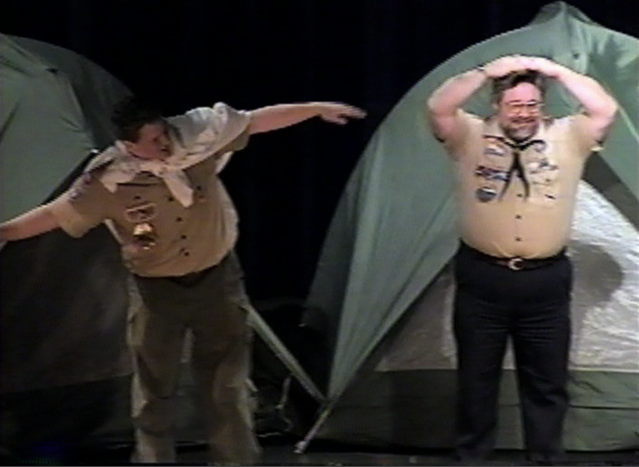
To many of the Boy Scouts who have played Dungeons and Dragons (D&D) in my fictional world of Tenne the countries of Givemea, Acirema, and Minta are almost as real as Brazil, Germany, and Egypt. They know the cities of Givemea, Pleasantville, and Dogrum almost as well as Sauk Centre, St. Cloud, or Duluth. Games have been played in the forest, the desert, the plains, and the mountains.

When a new player begins playing I will usually start him out with a human character. Once he has joined in several games and learned the basics of the game he may chose to create another character of a different race. Elves and half-elves have been the most popular, but there have been dwarves, halflings, and gnomes. There have even been a couple half-orcs. My world is based on the first edition books so there are probably fewer races available to players then the current fourth edition books.

One feature of Dungeons and Dragons that I like as both a gamemaster and a scoutmaster is that the boys usually have to work together as a team to accomplish the game’s objective. They have to help each other battle the monsters. They have to brainstorm ideas to solve the riddles and traps. They need to protect each other through many situations.

Sometimes I like to add a special theme to a game to see how the boys will react in different circumstances. Some of those topics have included racism, chauvinism, homeless children, and slavery. It has been interesting to see how they handle these topics.

It has been fun to watch the development of villains in my world. Most of them only last for one game, but two villains have become legendary. Brutus, the human, and Gary, the green dragon, are villains that were designed to be in only one game but somehow became bigger, badder, and more villainous. Each became so powerful through various games that each were around for nearly a year’s worth of games before they were finally defeated.

Several of the boys have taken the time to write stories based on their character’s adventures. Those stories have been posted to a subsection of our troop’s website and to a special forum that has recently been created so the boys can post the stories themselves. The stories can be found HERE (site) or HERE (forum). Take a moment to read them. The boys have written them from their characters point of view.

For thirteen years the Boy Scouts of Troop 68 held an annual show they called Laughs For Lunch. It was a campfire-style show featuring various songs, skits, and stories. The shows made the new Scouts nervous because, for most of them, it was their first time on stage in front of an audience. The older more experienced Scouts loved performing in front of the crowd and getting the laughs. We usually tried to keep the younger Scouts in groups when they were onstage but the older boys would get the chance to perform a skit or song on their own. This video post to the Melrose Scouting Productions Podcast features one of those skits.
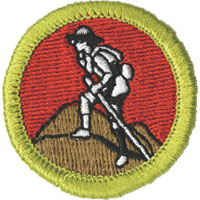
Andy may have been shy were he joined the Boy Scout troop but he soon became one of the guys who loved to ham it up on stage. In this video from the 2001 Laughs For Lunch Show, he plays the artist Vincent Van Go-Go who plans to create a living sculpture on stage using people from the studio audience. He soon has both young and old people on stage portraying trees, rabbits, birds, and other things from nature. I am sure you will enjoy watching it.

Does your troop have fun performing in front of an audience? Have they ever done this skit? Tell us about it by leaving a comment.

Click here to DOWNLOAD and watch this Podcast
Subscribe to Melrose Scouting Productions Podcast through iTunes.
or at http://feeds2.feedburner.com/melrosescoutingproductions
Check out other Scouting podcasts at PTC Media.

I almost wish I young enough to be a Boy Scout again. The merit badge I have been waiting for has finally arrived. Scouting Heritage is has been approved and is ready for Boy Scouts to begin earning. Since I am too old to earn it myself, I will be signing on as a merit badge counselor.

The merit badge requirements have been posted at scouting.org. It is not going to be an easy merit badge for a boy to earn. A Scout is going to have to interview at least three different people. He needs to create a Scouting memorabilia collection. Some research will also need to be done on Scouting’s history.

When I first read the requirements I thought that requirement #4 would be one that would limit many boys from earning the badge. It states:

  1. Do ONE of the following:
    1. Attend either a BSA national jamboree, OR world Scout jamboree, OR a national BSA high-adventure base. While there, keep a journal documenting your day-to-day experiences. Upon your return, report to your counselor what you did, saw, and learned. You may include photos, brochures, and other documents in your report.
    2. Write or visit the National Scouting Museum in Irving, Texas.* Obtain information about this facility. Give a short report on what you think the role of this museum is in the Scouting program.

I missed in 4b where it states “WRITE or visit” the national museum. Good thing I read it a second time.

What do you think about this merit badge? Are you as excited about it as I am? Leave a comment.