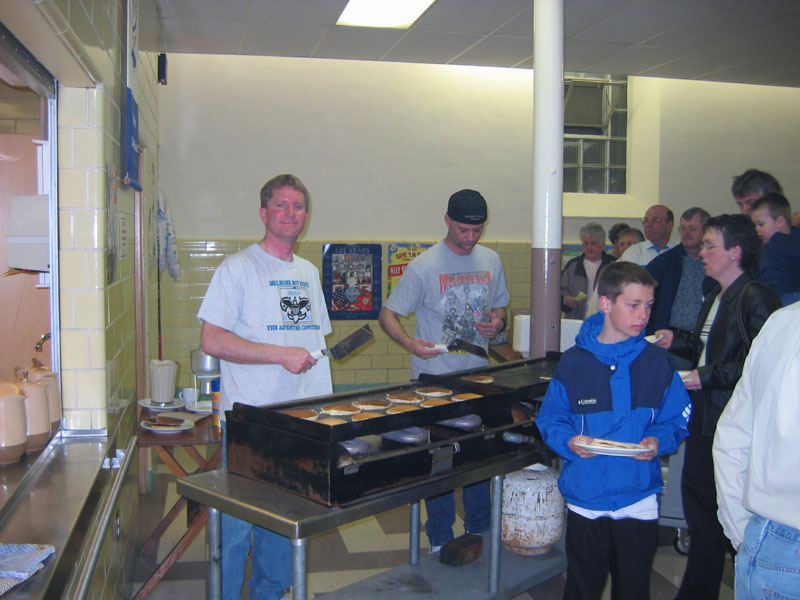
We all have to do it, although we would rather avoid it. Fundraising is a crucial item on every Boy Scout troop and Cub Scout Pack’s agenda. The big question seems to be, “How can we raise the most money with the least amount of work?” Sound about right? After twenty-six years of Scouting I can tell you what has worked well, and not worked well, for Boy Scout Troop 68.

We have tried several fundraisers throughout those years. We tried selling candies. They were not as sweet as we were hoping they would be. It can be tough to convince people to buy a candy bar for twice the amount for which they could buy one in the store. We tried selling seafood a couple times. The first seafood sale went fairly well so we tried a second one. Sales dropped significantly and left us feeling like we were left high and dry. We tried delivering phonebooks door to door in our community, but the boys lost interest in that very quickly.

For several years the troop sold Christmas trees. A local grocery store allowed us to use a portion of their parking lot to display the trees. The Scouts were assigned shifts after school to work at the tree lot. The profit made was divided by the total number of hours worked by the boys. Each boy received an “hourly wage” based on the profit made that was then placed into their individual accounts.

The trees sales went very well the first couple of years. Then things began to work against us. Sales began dropping as more people bought artificial trees. Troop membership dropped so we did not have enough Scouts to fill the shifts needed at the tree lot. One year several trees “disappeared” from the lot and cause a disaster in the profit made. We barely broke even that year. We finally dropped the tree sales as a fundraiser. A community of 3200 people just did not make it profitable enough during the last few years.

Our Boy Scout council does conduct an annual popcorn sales fundraiser as I know many councils do. We use this as an “optional” fundraiser for the boys in our troop. If they chose to participate they receive all the profit into their individual account. We do this as an optional fundraiser because our brother Cub Scout Pack uses this as their major fundraiser.

The troop best way we have of raising funds have been the pancake and sausage breakfasts we hold twice a year, once in the spring and once in the fall. I will make this the subject of my next blog entry.
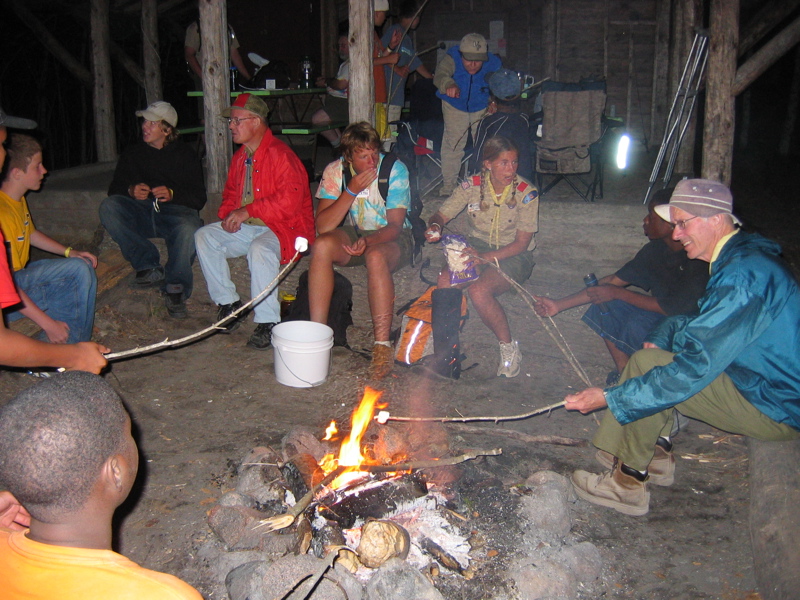
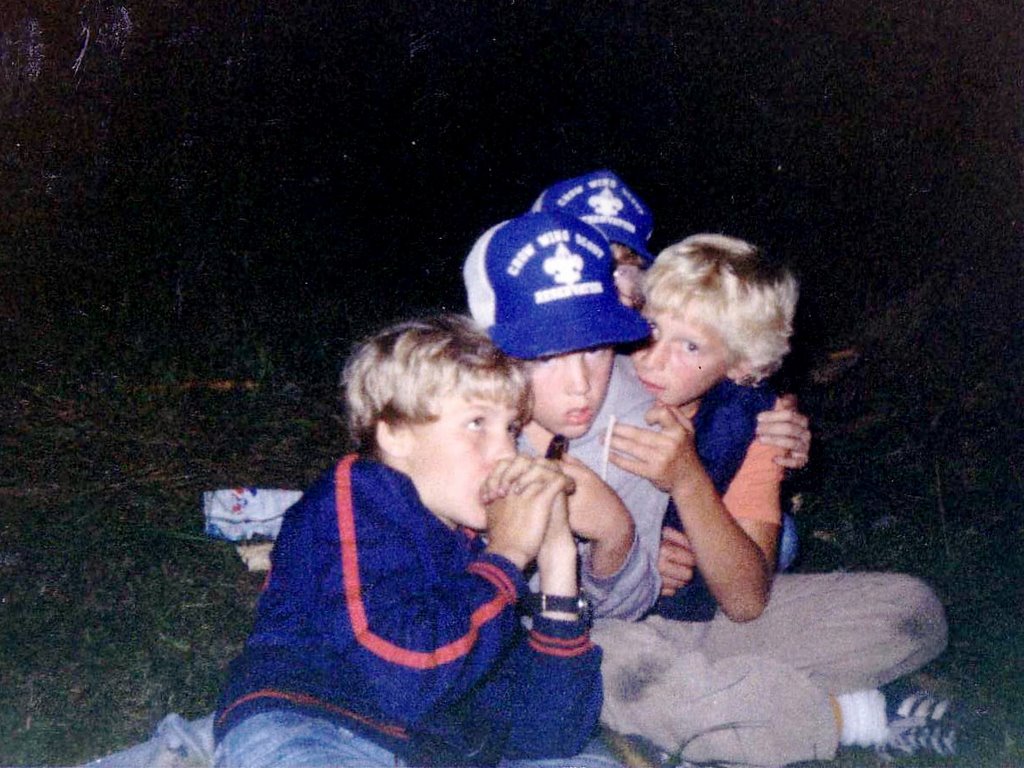
Telling stories around the campfire has been part of Scouting since the first Boy Scouts went camping. Boys and adults love hearing a good story while sitting around a crackling campfire surrounded by the darkness of the wilderness.

As my troop gathered around the campfire during the first night of a week long summer camp one year, I opened a book of short stories that I had brought along, and told the boys that I would read them a story each night before heading off to bed.

The younger boys were enthusiastic about hearing the stories. The older boys complained that they did not want to sit and listen to stories being read to them. I told them to sit back, relax, and listen. And I read them a different story each night.

Our last night in camp finally arrived, Friday night. We had just arrived back at our campsite after attending the closing campfire. It was late, everyone was tired. I thought the Scouts would want to go straight to bed. I was wrong.

I was surprised when the older Scouts asked me if I would be reading a story yet. These were the same boys that did not want to listen to stories earlier in the week. I smiled to myself and grabbed my book as the troop gathered around the campfire ring one last time.

Campfire storytelling is what I call the “mind’s television” for the Scouts when they are camping. It does not matter if the story is comical, serious, scary, or has a moral to it. If the story is told well it will hold the boy’s attention and have them using their imaginations.

I would suggest that every troop have at least one storyteller, be it an adult or an older Scout. The storyteller should have fun telling the stories, putting a little emotion into the tales, changing his voice a little for each character. The more the teller does with the story the more fun it will be to listen to it.

So next time your troop heads out to its campground do not be afraid to grab a good short story book and bring the magic of the mind’s television to your campfire.

In the previous blog entry I wrote about scary campfire stories. This time I would like to share with you a couple of experiences regarding the Wolfen story. The first time I told the Boy Scout about the wolfen was over 25 years ago. The troop was attending a camporee and we had a few Webelos Scouts staying with us. We were sitting around the campfire Saturday night when the boys first heard about these creatures.

I must have done a very good job of telling the boys about the wolfen. Shortly after I got home from the camporee I received a phone call a parent of one of the Webelos Scouts. He was a little upset that I would tell such a story to young Scouts who would become so scared they could not sleep during the night.

Okay, the lesson was learned. Do not send the boys to bed when they think there really is wolfen that could attack them during the dark night hours. So I changed the end of the story. Now, after I tell them all about the wolfen and how viscous they are, I look the new listeners in the eyes and tell them that the most important thing to remember about the creatures, the one things that will save them from being attacked during the night, is to remember that they are not real, that they are fictional creatures from a book I read.

There always seems to be the sigh of relief and maybe a nervous chuckle, from the new boys after I tell them the wolfen do not exist.

One winter, while we were at Parker Scout Reservation, we invited another troop that was also there that weekend, to join us for a campfire program at our building. We had a large fireplace so it would give us a little of that outdoor campfire feel to the skits and songs.

The program ended with me telling the Scouts from the other troop about the wolfen. I also told them, at the end of the story, that the wolfen were not real creatures. The boys laughed and told me they knew all along that I was just telling them a story.

But yet, when the other troop left us to return to there own building for the night, the boys were huddled together tightly around their scoutmaster. My troop giggled as we watched them from our windows.

A few years later, that scoutmaster told me just how much the boys in his troop were frightened by the wolfen story. As his boys prepared to go to bed that night one Scout needed to visit the latrine outside of their building. He did not want to go out there by himself so he asked a buddy to go out with him. His buddy did not want to be standing outside all alone so it was finally decided that the boys would go to the latrine in groups of three. No one wanted to be outside alone, just in case that the fictional wolfen were not truly fictional.

It appears that even though I tell the Scouts that there is no such thing as the wolfen, their imaginations do not always get the message.

As Halloween approaches I cannot help but think of the “scary” stories told around the campfires during the last twenty five years of Boy Scouting. The first campfire “ghost” story I remember was from when I was a Boy Scout myself during summer camp at Parker Scout Reservation in central Minnesota. I made the mistake of sitting right in front of the storyteller, a staff member of the camp. He was quite good. When he screamed and lurched toward me at the end of the tale I literally jumped onto the Scout who was sitting behind me.

It was a great story! I wish I could remember it.

Now, I am the scoutmaster, the adult staffer. It has become my duty to tell the troop’s favorite stories at the campfires. I do not mind. When they are told well, a good story will hold a Scout’s attention as well as a television show or a video game. That is my goal while storytelling.

Over the years there have been three stories that have become the favorites of the Boy Scouts of Troop 68. The “Purple Gorilla Story” is one we first heard at summer camp. It is a story about a traveling salesman who’s car breaks down during a bad thunderstorm in the “middle of nowhere”. The story takes place in the days before cell phones. An elderly farmer, who lives alone, befriends the salesman and invites him to spend the night, but the farmer warns the salesman not to go into the cellar.

The story can be quite long as the farmer attempts to discover what the farmer is hiding in the cellar. It is a good story that can be very suspenseful, but not too scary or gory for the younger campers. In fact, the punchline of the story is really a…. Well, I would hate to ruin it for you.

The “Black Forest”, on the other hand, is a graphic horror story that ends with a short poem. It tells the tale of a family that inherits a cabin located in the Black Forest. During their first trip to the cabin a violent thunderstorm hits the area. One by one, the four family members are killed in mysterious ways.

The troop’s favorite campfire story is not really a story but more of a lengthy description of an animal that has been recently discovered by man. The creature is thought to have been around since before the dawn of mankind. This creature, the Wolfen, is thought to be the animal from which the legends of the werewolf evolved. The wolfen is nature’s ultimate fighting and killing machine, a natural hunter known to prey on mankind. Scouts usually do not want to go to the latrine by themselves during the night after hearing about the wolfen for the first time.

Of course, the real fun comes with the telling of the stories. Even a bad story can be pumped up and made more frightening with a little creativity from the storyteller. The Scouts have the imagination to create the images better then any Hollywood moviemaker could ever put on film.

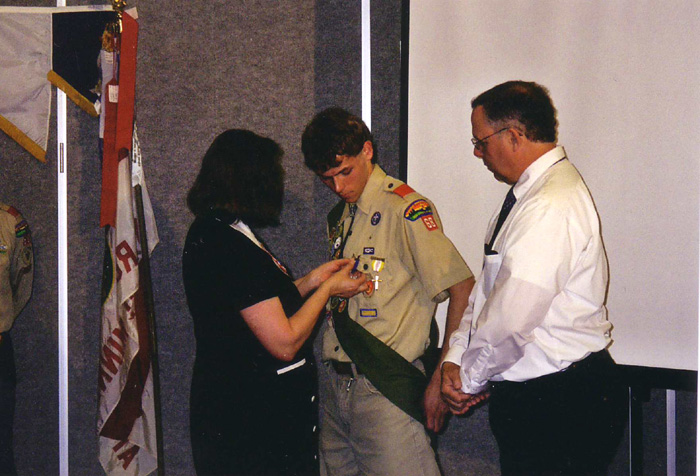
It was the weekend of Mike’s Eagle court of honor. I awoke Saturday morning with a song in the head that I thought would be great for the opening credits of the video I planned to create from taping the ceremony. I sat down at my computer, scanned some pictures of Mike from his years in Scouting, and began to edit the opening to the video.

I began taping troop courts of honor and Eagle courts of honor shortly after our city started a community access television station. I thought it would be a great way to add further recognition for the achievements of the Scouts, and it would be one more way to keep Scouting in the public view.

I always gave the Eagle Scouts a copy of the tape of their award ceremony. I felt that it would make a nice souvenir they could watch later in life. Did any of them ever watch the tape? I don’t know, but I hope they did.

Back to Mike’s court of honor….

Later that morning I received a phone call from Mike’s mother. One of the guest speakers had called her to tell her that he may be a little late arriving at the ceremony. She asked if I had any ideas what could be done to fill some time if he came late. I explained that I was editing a slideshow of pictures of Mike for the opening in his video. I could add more photos and lengthen the slideshow, thus making it into a four or five minute presentation. She liked the idea and offered to find some pictures of Mike from his years as a Cub Scout.

Thus, my two minute video opening became a four and one half minute presentation. The guests attending the ceremony enjoyed the slideshow, as did Mike and his family.

Since then, I have had to make a slideshow for each of the troop’s Eagle Scouts for their ceremonies. I have also had three Scouts from other troops ask me to edit a show for their court of honor. The slide shows have become quite popular. When I find the time, I have been making shows for the previous Eagle Scouts from our troop.

To date, I think I have done twelve Eagle Scout slideshows. Yes, they take some time to put together, but the smiles and chuckles from the guests, the families, and especially the Eagle Scouts, have made the time seem well spent.

Several of the slideshows can be seen on our troop’s website. Check them out at:
http://melrosetroop68.org/EagleHall.html
There are slideshows for about half of the troop’s Eagle Scouts so far, with more coming in the future.

In my last blog entry I asked the question, “Who’s job is it to promote Scouting?” I believe that the regional and national offices should be doing a better job of promoting Scouting within our states and on a national scale.

However, I will admit that troops and packs need to do some promotion within their own neighborhoods, and even in their cities. Here are a few ways we promote Scouting within our community of 3200 people.

The schools are always a good place to start, if the school district will allow you into the schools. The very loud and vocal minority of Scout haters has been trying to close down this option across our nation. This year we hung posters in both elementary schools. We also had a booth during the district’s open house held before school began.

Two local weekly newspapers have been very willing to print articles I write for them, along with one or two pictures per article. The articles usually pertain to a court of honor, or review what the Scouts did doing an activity or camping trip.

Our community access television station has been very supportive about playing shows we provide them with about our courts of honor and activities. Of course, I am usually the one filming, editing, and producing the videos. A local business sponsors the programs so there is not any airing cost to the troop.

The web is another way to promote Scouting locally. It is a great place to place pictures and keep the community informed. Of course, you need to get the word about your site out to your community. And you need someone to take care of it and keep it updated. Our troop has had a site for several years and has gotten to be quite large.

Last, but not least, there is old fashioned word of mouth. Scouts need to enthusiastically talk about Scouting to their friends and piers, and not hide the fact that they are a Scout as if it is something to be ashamed of being. The same applies to adults and parents. After all, if we are afraid to promote Scouting within our own community, what kind of message are we really conveying to others?

We have all heard the slogan, “Outing is half of Scouting”. It is very true, of course. Most boys are in Scouting for the outings. Now, let’s take the last half of Scoutng and apply it to a different word that is equally important – promoting. I think Boy Scouting could use a lot more promoting. Think about it. Membership is down nationally. Councils have a hard time meeting their goals. Many troops are having a hard time recruiting members.

Promotion is essential for success in today’s world. A business advertises to bring customers through its doors. A new video game is promoted and sells millions of copies. Promotion is done nationally, locally, and even through word of mouth.

But when do we see Boy Scouting being promoted? Almost never, at least around these parts of the country. However, I see plenty of negative news about the BSA in the newspapers, on the internet, and on the national news. What kind of opinion does the pubic form about Scouting when that is all they see or hear?

And where is the National BSA during all of this? They seem to be comfortable sitting silently behind their desks in Texas, making the occasional public statement. They need to get out of those padded office chairs and start talking to people working with the boys more often.

Those of us invovled with the Scouting program know it is one of the best programs available for a young man to belong to. But with all the negative news and stories over the last few years there are now many boys and parents who may have the impression that Scouting is a thing of the past.

Hogwash! I say. Boy Scouting and its ideals are more important now then ever. But we need to get the word out about it, and what the program offers boys and their families.

So, who’s job is it to promote Scouting? Most troops and packs do not have the money, people, or skills to do it. I would think it is the council’s responsibility to do local promotions. But it must be the regions and national offices responability to promote Scouting on a larger scale. If they don’t, then who will? The national office needs to promote Boy Scouting in addition to Cub Scouting! I am so sick of seeing so much effort going to the Cubs, and almost nothing going toward the older boy programs. (Unfortunately, if a boy quits during Cub Scouting it is very difficult to get him involved with Boy Scouting.)

Okay, that is enough of my ranting and raving for now. I welcome welcome your comments and opinions. Do not be afraid to leave a comment.

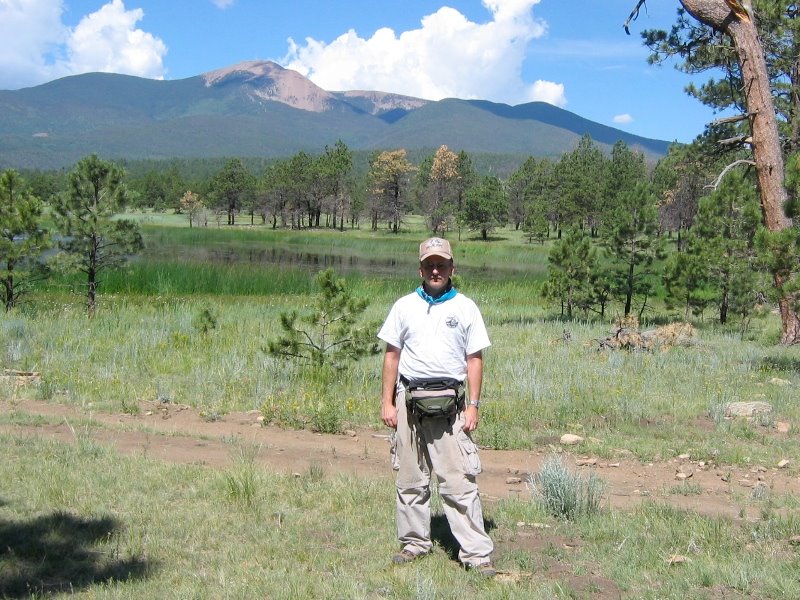
Well, it has finally happened. I guess you could even call it a milestone. I have been the scoutmaster of Melrose Troop 68 for 25 years! A quarter of a century. Over half of my life. I thought I was scoutmaster for a long time when boys started joining the troop who were born after I became scoutmaster. Now I have parents of Scouts who are younger then I am.

When I look back at those 25 years I have a lot of great memories. Oh, there are a few memories that are not so great, but I can honestly say that I have enjoyed most of my time spent with the program.

As this milestone approached I began to think about all the time I have spent on Scouting, and what the statistics would look like. I would like to use this blog to share those stats with you.

I have been to 18 week-long summer camps. I have been to Philmont Scout Ranch six times, five on a trek and one for scoutmaster training. I have been to the High Knoll Trail of Virginia, and Charles Sommers Canoe Base in the BWCA. In 2001, I was the scoutmaster of Troop 1417 at the BSA National Jamboree.

I have attended nearly 270 monthly troop outings. Over 170 of these were weekend camping trips and activities. I have been to 25 troop yearly planning sessions, over 270 committee meetings, and close to 275 patrol leader council meetings. I have lost track of how many district roundtables I have attended.

There has been over 100 courts of honor held during those years. I have seen fifteen Boy Scouts from Troop 68 receive the rank of Eagle Scout. Twenty-two other Scouts made it to the rank of Life Scout. Nearly 250 boys have had me as their scoutmaster.

These statistics represent the time I have spent with the Scouts of Troop 68. They do not include the time spent on the district, council, or national level.

After 25 years I can honestly say that I have enjoyed, and been honored, to spend this time with the Boy Scouts of Melrose. I would like to thank them, their parents, and everyone who has helped with the troop over the years.