In the 1980’s, when I began attending monthly training meetings, the district had a great roundtable staff. They were well trained, prepared for the subjects, and they made the roundtables fun.

Paul was the roundtable commissioner. He had sons of his own in the Scouting program and had held several positions within Scouting, including scoutmaster. He seemed to be very knowledgeable about every aspect of the Scouting program. Paul was a Scouter that I looked up to. Over the next few years he became my mentor and one of my best friends in Scouting.

Once I had attended roundtables for a few years Paul invited me to join his staff. I was in my mid-twenties and did not feel very comfortable about training men and women who would be older then myself. I think Paul saw something in me that I did not see in myself.

During the next few years, under Paul’s guidance, I began refining my Scouting skills as an adult leader. One trick that Paul loved to do to me was to place me in charge of a subject for the next roundtable that I did not know a lot about. So, I had one month to learn about it. The trick worked very well, although at the time I did not always appreciate it. I learned a lot under Paul’s instruction. He soon encouraged me to be a staff member for the Scouting University and the weekend scoutmaster training sessions. We even experimented one year with a junior leader roundtable.

I soon became more comfortable speaking in front of groups of people, something I had hated doing in high school. My voice started cracking less and less, my palms became less sweaty, and I did not shake quite as much as I used to. I began to become more confident in myself as my knowledge in Scouting increased.

As adult leaders we always like to brag about how Scouting can help our boys, but I think we also need to remember what Scouting offers adults who are willing to apply themselves to the program. I, for one, have grown more as a Scout leader then I ever did as a Boy Scout. I am sure that I am not the only one out there who can make that claim.

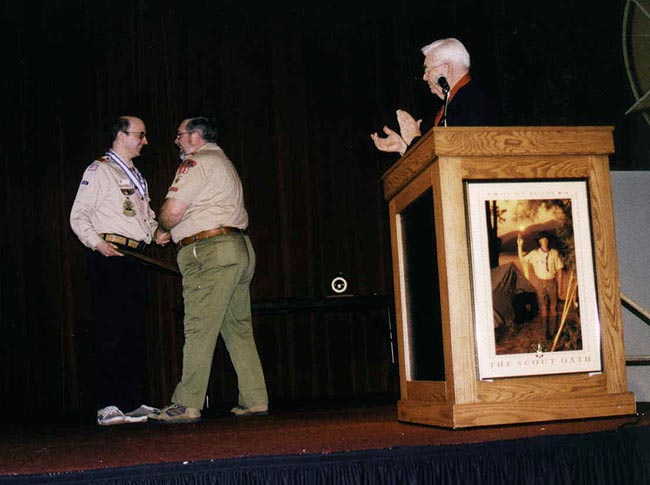
Twenty years after those roundtable staffer days, I received the council’s highest award, the Silver Beaver. I invited my parents to the award ceremony. (I am not married so there was not a wife to invite.) I also asked my old roundtable commissioner, mentor, and friend to attend the dinner and be the person who would present the award to me. Both Paul and I were grinning wide as he placed the Silver Beaver award around my neck.

Should you attend your monthly roundtable meetings? You bet you should! And apply yourself to the leadership roles you have accepted. After all, look where it got me.

I began attending monthly district roundtable training meetings shortly after becoming an assistant scoutmaster in 1980. I was a firm believer that this ninety minute training session would help me in my new position. I still attend many roundtables, even though I have been in Scouting long enough to conduct the meetings myself. I still pick up a couple things here and there that are useful.

Those first years of roundtables were critical in my leadership training. Oh yes, I did also attend the weekend scout leader training session and the yearly Scouting University, but it was during the roundtables that I really got to know the other Scout leaders in my area.

I live in Melrose, a city of approximately 3000 people. Nearby cities are 6-7 miles apart with a lot of farm land between them. Interstate 94 runs through the south portion of Melrose. The Central Minnesota Council office is located in St. Cloud, thirty five miles from my home. A couple leaders from neighboring cities and I would carpool to the meetings. During that 30 minute drive we would discuss various Scouting topics and sometimes talk about current problems we had within our troops. The same thing would happen on the way home, although the meeting may have given us a new topic to discuss.

One advantage in attending these monthly meetings was forming new friendships with my fellow Scouters. I am pretty shy by nature so it was great to be able to share experiences and to have them there to help solve problems.

The members of the carpool soon decided to stop for supper after the roundtables since we did not have the time to eat properly between getting home from work and getting to the meeting. We made a habit of going to Bonanza in St. Cloud. These “after-roundtable roundtables, as I liked to call them, became another important element of my training and friendship making. It did not take long for other Scouters to discover our after-roundtable roundtables. There were times when we would have eight to ten leaders, in Scout uniform, sitting at a table in Bonanza, shooting the breeze and solving all of the problems in Scouting. We had a great time.

Currently, I am the only member of those early roundtable years that is still involved in Scouting, at least locally. Most of those guys have retired from Scouting or moved on to other locations. I, however, am still making new friends at the roundtables. A couple months ago, four of us stopped at a local dining place after the meeting for some snacks and something to drink. We talked about Scouts, the Order of the Arrow, and the council’s camp.

Who knows… Maybe the after-roundtable roundtables will become popular once again.

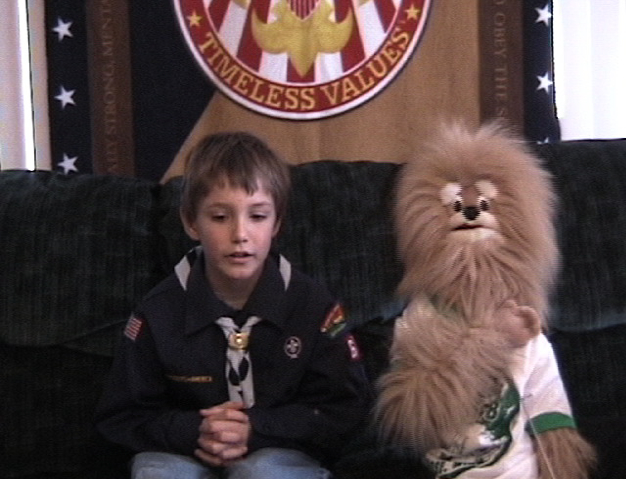
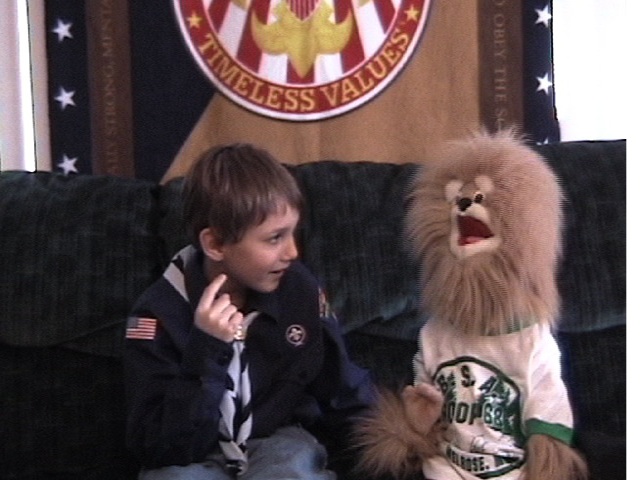
Buttons, the radical Boy Scout, has almost learned the Cub Scout Promise from Michael, the Cub Scout, in the newest video. This time the two get sidetracked and start talking about long hair and hockey. This is the third video featuring Buttons and Michael.

The video can be seen at
YouTube:
http://www.youtube.com/watch?v=yOW_kXbrjpc
or
Troop 68’s web site: http://melrosetroop68.org/videos.html

Thank you for watching the videos. We hope to be making new ones this spring when the weather gets nicer as we take Buttons out into the campgrounds with the Boy Scouts. Leave a message and let me know what you think of them.

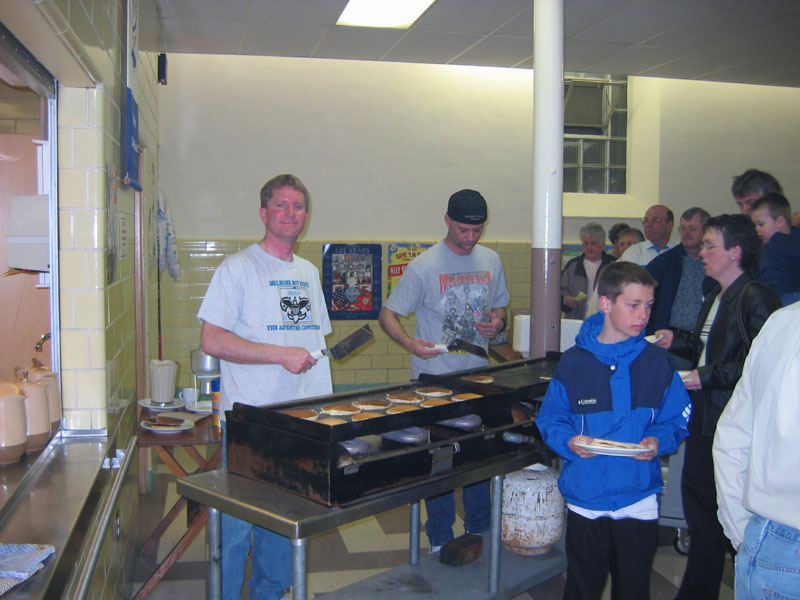
The troop’s spring fundraiser, a pancake and sausage breakfast to be held on Palm Sunday, had it’s kick-off Monday night as the Scouts used their meeting night to begin selling tickets in our community. This breakfast has been a great fundraiser for over 20 years, and usually adds over a thousand dollars to the troop treasury.

During the ninety minute first night kick-off we pair up the Scouts and, using maps of the city and parents for the transportation, send the boys into their sections to sell as many tickets as possible. We we had a larger troop of over 30 boys we could cover most of the town and sell enough tickets to pay the expenses of the breakfast. Now that we have a small troop of only ten members we may sell enough to pay for half of the expenses.

A percentage of the ticket sales in put into a kitty which is evenly split between the boys who work that first night. This credit is then used to pay camp costs. After the first night, the Scouts and parents continue to sell tickets on their own time. The boys receive camp credit for those sales also.

Several years ago a few of the younger boys came back after the first night of selling with tears in their eyes. Some of the older boys were very frustrated. Unfortunately, some people were very rude to the boys when they answered their door. Others made up excuses or out right lied to the boys to avoid having to buy a breakfast ticket. “I already bought my tickets,” was the most popular lie, which was impossible because the boys had just received their tickets. “I will be out of town,” was said before the boys could even tell them the date of the breakfast. “I will get my ticket from the girl scouts,” was my favorite. (Umm, excuse me. This is a BOY SCOUT fundraiser.)

The next time we had a ticket sales kick-off I made a game of it. I told the boys to remember the excuses given to avoid buying a ticket. When the boys returned we had a few good laughs over those reasons, instead of a few tears over hurt feelings.

My question to those people is a simple one. Why do you lie to the Scouts? We try to teach the boys to be honest and trustworthy and you lie to them, looking them in the eye as you do it. If you would just tell the Scout, “No thank you, I am not interested”, the Scout would understand, thank you for your time, and move on to the next home. Is that too much too ask? I would hope not.

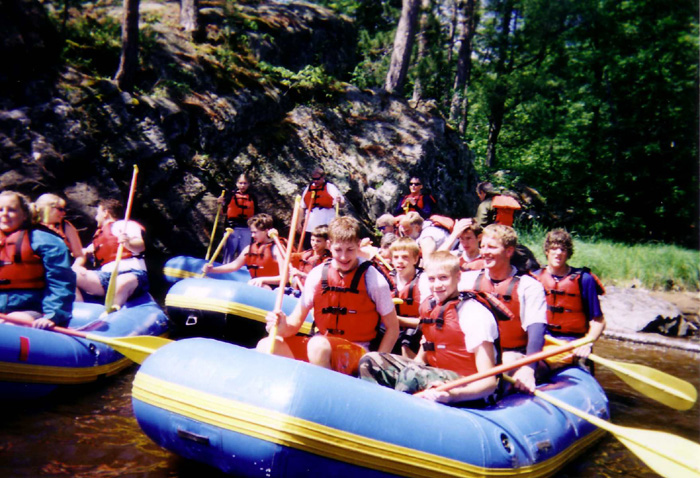
Several years ago our troop held a weekend camping trip at a public park at Lake Koronis in Minnesota. Activities included swimming, volleyball, football, and a massive water balloon fight. A few fathers attended this activity to provide leadership and transportation. This camp location was so popular that Scouts of all ages were in attendance. We had an excellent turnout.

The outing was a blast! Everyone, Scouts and adults, had a great time. As we sat around the campfire Saturday evening I asked the campers what they liked best about the outing. One of the older Scouts gave me an answer that caught me by surprise, and it is something I have never forgotten. His highlight was when the fathers played football with them (the Scouts). I saw a few other boys nodding their heads in agreement.

That simple statement hit a nerve with me. It suddenly occurred to me how seldom today’s teens get to play with their fathers. Teenage boys love to play. It is a part of their nature, part of how they identify themselves, part of how they learn to cooperate with others.

Unfortunately, in today’s world, fathers do not seem to have enough time to play with their sons. They work long hours, have more work to do when they get home, and often are too tired in the evening to do much more then sit in front of the television with the kids. Oh, and mom would like a little of his time also. Of course, this assumes that there is a father living at home.

Today’s teenage boys are not much better. They spend half of their day in school. Many are involved in school sports or some other extracurricular activity. Some have part time jobs. They need to spend time with their buddies, and maybe even with a girlfriend. Then add video games and the internet into the mixture.

Each generation has their excuses for not spending time with other, which made the impact of the Scout’s statement that weekend all that much stronger to me.

Hey Dad! You need to get out and play with your son! He will only be a teenager for several years, years which pass by very quickly. He will soon be leaving to go to college, make a life for himself, and probably start his own family. If you think it is hard to find time to play with him now then just think about how hard it will be once he moves out.

Hey Son! Put down that video game controller, grab a football or basketball, and take your father outside to play. Sure, it may seem like dad has forgotton how much fun it was to have fun and play, and you may need to help him relearn how to be a kid again. He has a lot on his mind but he needs to let it go once in awhile and have fun sometimes too.

This is one reason why I think Scouting is such a great program. Fathers and sons can spend time with each other outdoors and play together. Scouts, you may need to ask you father to join you on an outing or two. Dads, you need to get out of that lawn chair and run around a little. I think I can safely say that it would be a win/win situation for both generations.

I grew up in a small town of about 2500 people in central Minnesota. My father was the local milkman, delivering milk daily to people’s homes. Everyone in town knew my dad. Thus, everyone in town knew me as Tom’s son.

Just like most young men in their late teens, I thought it would be great if people would know me as Steve, not as Tom’s son. I wanted to make a name for myself. Unfortunately, I was not an athlete, was not the smartest in my class, and did not have a skill to make people take notice of me. I was just another face in the crowd. A face that belonged to Tom’s son.

I graduated from high school and began attending a technical college. One month before graduating from college I accepted a job in my home town, of all places. So, I moved back to Melrose and began making a name for myself. I began to move out of my father’s shadow.

During those first five years of life on my own, I became very active in the community. I was a seventh grade religion teacher for three years, a city council member for two years, and joined the newly formed Boy Scout troop as an assistant scoutmaster. Shortly after I turned 21 years old, the troop committee appointed me as the scoutmaster. (See an earlier blog about this story.)

I have kept active in the community since those days. I have been a member of the local cable access television station for over 16 years. People in town now know me for my accomplishments. And my greatest accomplishment? I would say it would have to be that I have been the scoutmaster of the troop for over 25 years, and helped to provide the Scouting program to over 250 boys.

Oh, I am still known as Tom’s son to the older population of the community, and you know what? I do not mind anymore. In fact, I am proud to be Tom’s son. I hope I have made him proud enough to be known as Steve’s father.

(Note – My dad is on the right in this picture. The other gentlemen was my scoutmaster.)

The latest of the videos featuring Buttons, the radical Boy Scout, has been posted. He is still trying to learn the Cub Scout Promise from Michael, the radical Cub Scout. Unfortunately, Buttons is not the brightest Cub in the Pack. I am sure you will get a chuckle or two from this, the second video of this series.

You can see it at:
http://melrosetroop 68.org/videobutt onsCub2.html
or
http://www.youtube. com/watch? v=YCTPDokPBnw
(If you watch it on youtube be sure to leave a comment and rate it.)

Thank you to everyone who has watched the first of the Cub Scout Promise videos. It has
become one of the most popular videos I have made. Between the two sites it has been
watched over 1000 times during the last 2 1/2 weeks.

The Boy Scout advancement program was quite different in the 1970’s from what it is today. Earning skill awards was a standard requirement for the first three ranks. The skill awards were a metal belt loop, similar to some of today’s Cub Scouting awards. There was twelve skill awards designed to introduce Scouts to skill areas such as camping, citizenship, first aid, and other basic Scouting skill areas.

Another change in the rank requirements was that A Scout needed to earn at least one merit badge for every rank. Yes, you read that correctly. A Scout needed to earn a merit badge for the rank of Tenderfoot, in addition to two skill awards.

Things sure have changed since then. Merit badges are no longer needed for the ranks of Tenderfoot, Second Class, and First Class. Skill awards were discontinued in the late 1980’s. The BSA seems to change portions of the advancement program every few years to keep it relevant to today’s world, while still trying to maintain the traditional Scouting values and ideals.

I have nothing to brag about when I talk about my advancement while a Boy Scout. I was a Scout for three and a half years, but I only reached the rank of Second Class. The rank of Eagle Scout was not even in my sights. I did earn several skill awards and three merit badges, including Pioneering and Reading.

The worst thing about the advancement program when I was a Scout is that I do not remember receiving the awards. I earned them, I still have them, but I do not remember a single court of honor during my years as a Scout. I honestly could not tell you if we even held a court of honor back then. I certainly do not have any pictures from such a ceremony.

Today, I am the scoutmaster of the troop in my hometown. We now hold courts of honor four times a year, whether we have 20 merit badges and ten ranks to present, or if we only have one merit badge to hand out. We try to add some humor to the ceremony and make it fun for the Scouts and the parents while still maintaining the dignity and solemnity of the actual presentations.

As a Scoutmaster, I want the Scouts to look back and to remember their award presentations as a positive moment of their Scouting years. I hope they will not think back and have no memory of such an important Scouting event as, unfortunately, I do.