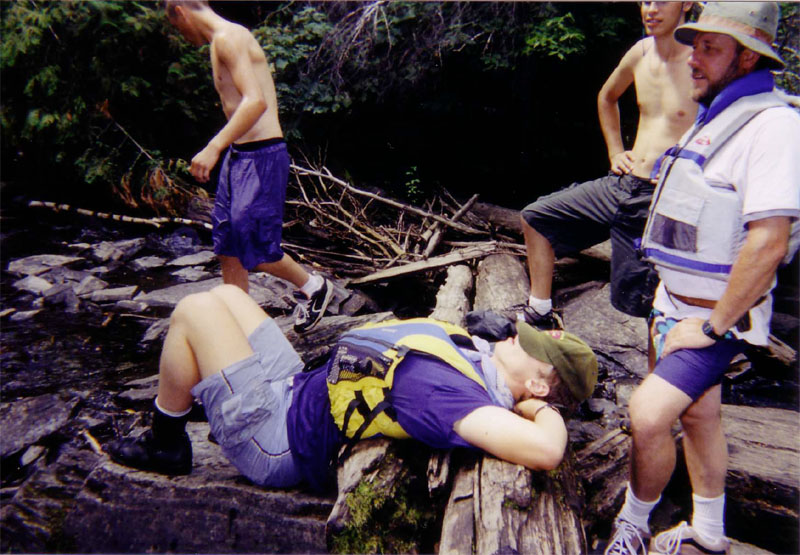
In 2002, Troop 68 sent two crews to the Charles Sommers Canoe Base near Ely, Minnesota, to canoe through the Boundary Waters Canoe Area. This was the first time Troop 68 had sent anyone to this high adventure base that was practically in our own backyard. One crew consisted of the older Boy Scouts, 15-17 years old. The other crew was made up of the younger boys. I was one of the two adult advisers for the older boy crew.

We were assigned an interpreter when we arrived at the base camp. A CSCB interpreter is similar to the Philmont ranger. The interpreter prepared us for our five day trip, helped us to plan our trip through the BWCA, and then went on the trip with us, providing pointers and how-to advice along the way.

Our interpreter, Sinclair, was a very nice guy who really knew his stuff. We could tell he loved being a part of this high adventure base. He was easy to get along with and the Scouts enjoyed having him around. He also had the ability to fall asleep easily, in any position, and at any time. When we would take a rest break there would be Sinclair, sleeping on top of a fallen tree. Once camp was made for the day Sinclair would disappear into his tent for a quick nap.

We had no problems with Sinclair taking a nap. In fact, I envied him being able to nod off so easily. One of the first days though, it backfired on him. He was taking a nap in his tent after camp was set up. The Scouts had begun cooking the evening meal. They used every pot that we had brought along on the trip. Sinclair was not a happy camper when he woke up and all the messy pots. He had a nice chat with the Scouts about one pot meals, or at least using as few cooking utensils as possible. The next day we noticed he did not take a nap if there was work to be done by the crew.

Like I said, he got along great with the crew, both the boys and the adults. The boys enjoyed the trip so much that they wrote a poem about it, including various events along the way, the food, and of course, our interpreter’s naps. One crew member read the poem during the closing program at base camp our last night. I think Sinclair was a little embarrassed. Here is is for your enjoyment….

And The Interpreter Slept
written by The 2002 BWCA Crew B, Melrose Troop 68

Our trip to the BWCA
began one glorious day.

The interpreter was late to eat.

He jumped to another when they would meet.

Then our interpreter slept.

We paddled through the rain
though a lot we did gain.

A downed tree interrupted our strut

We realized through it we must cut.

And our interpreter slept.

Through the deep mud we did trudge
All but two were stuck in the sludge.

Before a picture we took

No one escaped from the gook.

And our interpreter slept.

Though the portage had been tread
by two we still had not been fed.

To get us anything to eat

We pumped and pumped and pumped ‘till vee vere beat.

And our interpreter slept.

When it came time for supper that night
We used every pot in site.

Sand infiltrated the sweets we ate.

“It’s crunchy. It tastes like cereal. It’s awesome. It’s great!”

Because our interpreter slept.

Through the rapids we did walk
Though at the site of a ruined canoe we balked.

And though Ben’s hand was half ruined

all replied, “Tis only a flesh wound!”

As our interpreter slept.

Our interpreter could not count ‘til eight
so we had to share the food we ate.

Since he could not seem to count past six

We taught the Magic Eskimo Counting Sticks.

Then our interpreter slept.

Our Scout leader got us lost
to a lake only dogs cross in frost.

It took us out of our way

Adding two miles to our day.

While our interpreter slept.

A portage with rollers and a dock
Got us over with an easy walk.

The portage seemed to be a cheat

though Mike continued to loose his feet.

And our interpreter slept.

Schwieters took the rap
because our eggs tasted like cr___.

We took the portage two miles long

through a rain that could drown King Kong.

And our interpreter slept.

We arrived early to base
through the cold hard rain with haste.

So we finished our Northern Tier trek

Happy, but severely bent to heck.

And the crew finally slept.

**By the way, if you would like to see pictures from the trip check out of troop’s high adventure page by clicking HERE.
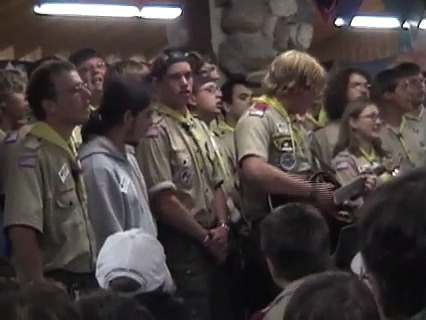
Some of the best things about attending summer camp are the campfire programs at the beginning and the end of the week. The 2007 staff of Buckskin Camp of Many Point Scout Camp did an excellent job of keeping everyone entertained during this summer’s opening campfire program. Due to a rain storm that happened to wonder into camp that evening, we had to have the program in the dining hall. The location did not damper the spirit of any of the Scouts, leaders, or staff. Everyone had a great time.

This video of the Melrose Scouting Production Podcast features the Buckskin Staff singing a song about Scouting as the campfire program came to a close. I do not know what the song is titled, but it is a great song that includes the twelve points of the Scout Law. It is a catchy little tune and I find myself humming it while I write this blog entry. Enjoy it and tell your friends about this podcast.

Download Video Podcast
Watch Video on the troop’s website.
Subscribe through iTunes.

As I was posting the previous entry to this blog, I began thinking about other multi-generational families of Melrose Boy Scout Troop 68. There have been a few of these.

Jerome is two years younger then I am. We were both members of the Falcon Patrol in the mid 1970’s. His younger brother, Shawn, joined the troop in the 1980’s, a few years after I became the scoutmaster. Their nephew, Zack, is currently a member of the troop, in the Nighthawk Patrol.

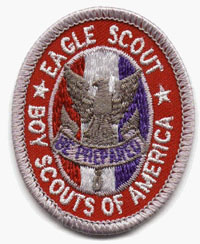
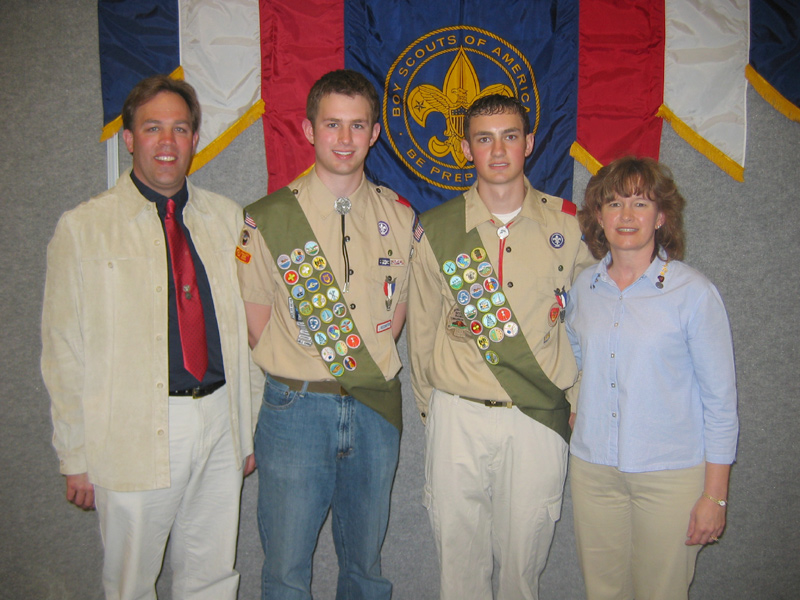
John was also a member of Troop 68 when I was a Boy Scout. John grew up, got married, and moved to the Twin Cities area. When he moved back to Melrose his sons joined Troop 68 as they got old enough. John’s two oldest boys, Nick and Jacob, have both earned the rank of Eagle Scouts while members of the troop. His youngest son, Lucas, joined the troop early this year.

Bill was an adult leader of Troop 68 in the 1960’s. One of his youngest sons was a member of the troop when I became the assistant scoutmaster in 1980. Bill’s grandson, Chris, joined the troop in 2000 and last year was awarded the rank of Eagle Scout.

One final note about spanning the generations. When I was a student in high school I never gave a thought to being a scoutmaster when I became an adult. I found it interesting that many of the members of the troop committee who appointed me as the scoutmaster were former high school teachers of mine. I am sure it never occurred to them that one of their students would one day be in charge of teaching their sons the skills needed in Boy Scouting.

A little ironic, don’t ya think?
.

I began my career as a Boy Scout troop leader early in my life. I was only a few months shy of my twentieth birthday when I became the assistant scoutmaster for Troop 68. Two months after my twenty-first birthday I was appointed the scoutmaster, a position I still hold today. There have been a few unique markers along this highway of my Scouting life that I would like to share with you.

The first marker was when I became the scoutmaster. Suddenly I was “responsible” for the troop. I was not the young assistant scoutmaster any longer who was practically still one of the gang. I was now the adult “figurehead” of Scouting in town. More then anything else, becoming the troop’s scoutmaster marked the beginning of my adulthood.

During the eighties the troop began going to Philmont Scout Ranch. I will admit that one of the reasons I stayed on as a scoutmaster is because I wanted to go to Philmont. I went to Philmont in 1986 and 1989 with the Scouts from Melrose. That first decade seemed to go by pretty quickly.

The second marker caught me a little off guard. Boys began joining the troop that were born after I signed on as an assistant scoutmaster. Two years later boys entered Scouting that would come to know me as the only scoutmaster in Melrose during their lifetime. I was beginning to feel old at thirty-one.

The third marker was when I began receiving invitations to weddings of troop alumni. I was even asked to be the best man at one of those weddings.

The fourth marker was when I noticed that the parents of some of the Scouts were younger then I was. Holy cow, I thought. I have been doing this scoutmaster thing for a long time. I was really starting to feel older.

Another marker came along when next generation cousins of former troop members began joining Scouting. In fact, my assistant scoutmaster, who is eighty years old, joined the troop when his youngest son was a Boy Scout. Since then, two of his grandchildren, sons of my assistant’s oldest son, have been members of the troop. I have seen three generations of this family involved with the Scout program on some level.

I think the next marker will be when the son of a former Boy Scout joins the troop. That has not happened yet, but it could. While most of the troop members have moved to other cities as they got older, there are a few that have decided to stay in this area. There seems to be more daughters then sons among that small group at the moment. I am thinking it may be time to retire when the first son of a troop member joins the troop. (he writes with a grin on his face.)

Whoever says that one person cannot make a difference obviously has not met Eagle Scout Andrew Larochelle. Check out what he did by reading this article in the Philadelphia Inquirer which was posted on October 12th. It is great to see a Boy Scout making a positive difference in on country.

The first requirement for the ranks of Star, Life, and Eagle is to be active in your troop and patrol for at least 4 or 6 months as the previous rank. This is a pretty vague requirement and can be one that troop leadership can struggle with sometimes. What does it mean to “be active” in the troop and patrol?

The national BSA website states:
A Scout is considered to be active in his unit if:

  1. He is registered in his unit (registration fees are current).
  2. He has not been dismissed from his unit for disciplinary reasons.
  3. He is engaged by his unit leadership on a regular basis (Scoutmaster conference, informs the Scout of upcoming unit activities, through personal contact, and so on).

The unit leaders are responsible for maintaining contact with the Scout on a regular basis. The Scout is not required to attend any certain percentage of activities or outings. However, unit leaders must ensure that he is fulfilling the obligations of his assigned leadership position. If he is not, then they should remove the Scout from that position.

Okay, that made things crystal clear, didn’t it? I think that statement made things even more confusing for scoutmasters and troop leaders. Let me explain my view on this BSA statement.

If you read this as the “letter of the law”, a Scout only needs to be registered to “be active”. He does not need to attend any troop meetings or troop activities. It seems to be the scoutmaster’s and unit leadership’s job to contact him and tell him what the troop has coming up, but gosh, he does not need to attend them. Um, excuse me National Office, but how is a Scout to be considered active if he does not attend meetings and outings? (Keep in mind, I am only writing about being active, not about his position of responsibility.)

I understand National’s statement of “The Scout is not required to attend any certain percentage of activities or outings.” Every Scout is not going to make every meeting or activity. A youth in Scouting is usually active in other groups and activities. If he is in sports then practice and games will conflict with Scouting. Family schedules conflict with Scouting. Even homework can get in the way of attending a troop meeting. So yes, I agree that we cannot impose a percentage requirement on attendance.

When I meet with new Scouts, and Scouts during their Scoutmaster’s Conference, I tell the boys, and parents, that I would like them to set a goal of attending at least two thirds of the troop meetings and at least half of the outings. This is a goal, a guideline, for the boys to follow. An example – I have had several Scouts over the years that have been involved in high school hockey. They sort of disappear from Scouting during those three months of the season. But they still try to make meetings and activities when they are able to. This is a sign to me that they want to be active in the troop. Once the season is over they return to the regular schedule. I can live with that.

According to this statement from National, it seems that a Scout would never have to attend a meeting or activity to qualify as being active in the troop. Sorry, but I do not agree with that. It is not fair to the boys who are active in the troop. A Boy Scout must make an attempt to attend meetings and activities. Would a coach allow a player to play in the game if he never showed up for practice? Would the the school allow a student to letter in an activity if he did not participate in that activity? Would an employer keep employing a young man if he did not show up for work when he was scheduled? No, no, and no.

Part of the Scouting program is to teach the boys responsibility. A Scout needs to attend troop functions, or at least make a good attempt to do so. If a Scout does not want to actually be active in the program then he needs to make a decision whether to continue his membership. Sorry National, I am not signing off a boy just because he is registered and because I talk to him a few times. A Scout will need to attend troop meetings and functions, not just meet with merit badge councilors, if I am to sign my name to that advancement form.

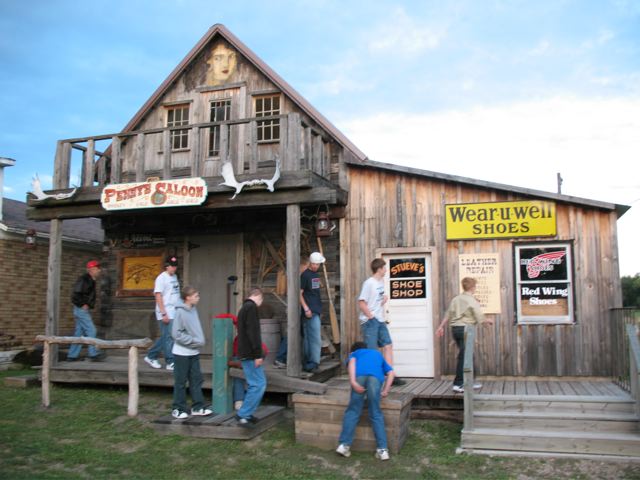
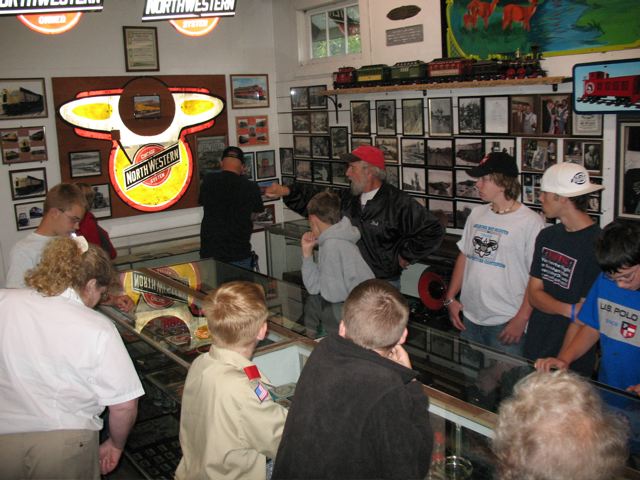
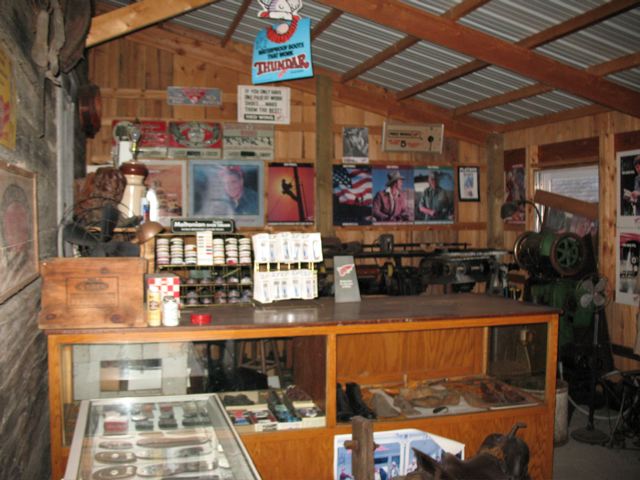
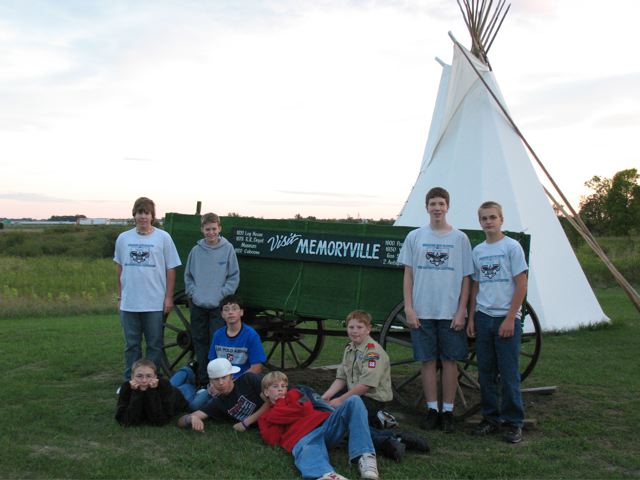
The Boy Scouts of Melrose Troop 68 recently took a tour of Dick Young’s Memoryville which is located west of Melrose. Mr. Young was the Scout’s guide as they went through several of the historical buildings on the site, including a railroad depot, a country school house, a one truck fire station, and the Spur gas station that once was found on Main Street in Melrose. The Scouts, leaders, and parents were amazed as they walked through the buildings, each a museum in itself. The train depot was full of train memorabilia from the last hundred years. The school house was complete with old desks, maps, and books from over fifty years ago. The visit served as a great field trip for the troop as they discovered a few new things about the history of central Minnesota during their Local History month.

Update 9/23/19: I was contacted today that Memoryville has now permanently closed. Dick Young, the owner, wishes to thank everyone who has visited over the years.

Another Update 5/17/21:  It looks like Memoryville will be open this summer once again. Reservations will need to be made for tours. Some virus restrictions will be in place.

A slideshow of the Scouts 2007 tour can be seen at

             https://youtu.be/UHuVvCCoiko           

The Boy Scouts of Melrose Troop 68 enjoy performing in front of an audience. That is why they have done the annual Laughs For Lunch Show for eleven years. The Scouts also enjoy watching and being a part of campfire programs during camporees and summer camp. That is where they get many of the ideas, skits, and songs that they perform.

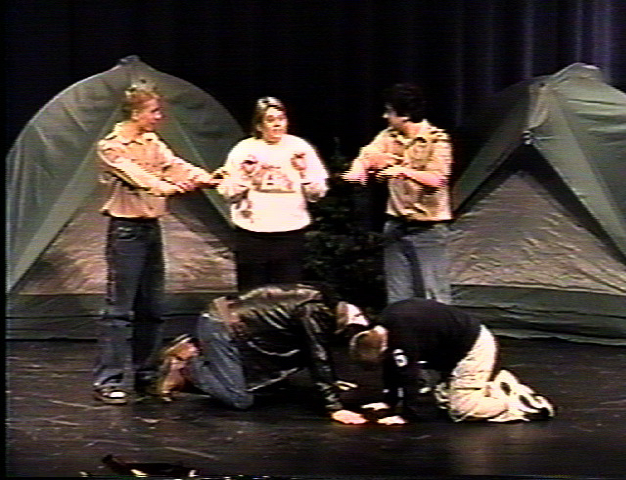
During the 2002 Laughs For Lunch Show two of our older Scouts did the Candy Store skit. This skit has been a popular one for the Scouts of Troop 68 since they first saw it performed at a summer camp campfire in the 1980’s. During this version of the skit, Jacob and Enrico, the two Scouts, decided to have a little extra fun with it. They knew this was probably the last time they would perform the Candy Store as Boy Scouts.

I think the two guys had planned a surprise before they went out on the stage. I believe they already had the “volunteers” in mind they would choose to be in the skit. The horsie ride was a new addition to the skit that we had never done before. Enrico chose his father to play that part. Jacob’s mother became the cash register. The part of the bench/counter that “broke down” was a buddy of theirs who had earned the rank of Eagle Scout. All the volunteers except one had already seen the skit and knew the punchline, but they were great sports about it and went along with the fun.

Have fun watching this podcast. It is a longer one, over eleven minutes, but I think you will enjoy it. Have your Scouts watch and practice it for their next campfire program.

Download Video Podcast
Watch Video on the troop’s website.
Subscribe through iTunes.