Archive for the ‘Leadership’ Category


The Scoutmaster Conference. There seems to be a lot of conversation, in some circles, about what this should actual be about, and what it should include. The BSA books seem to be a little vague about it and only give a few general thoughts on the subject. Some new Scout leaders seem to be confused when it comes time to have a conference with a boy.

I have been doing them for 25 years. I would like to share what I do during a conference. As you read this you may agree with some things, and you may disagree with others. The way I do it works for me, and it has worked for the Scouts who have done a conference with me. It helps them to think about some things, and helps to prepare them for their board of reviews. My assistant scoutmaster usually does the Tenderfoot through First Class Scouts, while I take care of the Star, Life, and Eagle candidates.

Okay, before I begin, here is a couple points I want you to keep in mind. A Scoutmaster Conference can be held at any time a Boy Scout needs one, not only when he is finishing a rank. The points I list here are my points for the conference requirement for the ranks. Another requirement for any rank is “Show Scout Spirit”. I take time during the scoutmaster conference to cover this requirement also.

When I do a conference with a Boy Scout it usually goes for more then the 15 “recommended” minutes. I try to get the Scout to discuss ten points (which I am about to discuss). And sometimes, actually many times, he will have something to say. It is our job as scoutmasters to encourage that dialog and try to keep our mouths shut while he is talking. Listen to him, and then guide him. It is not uncommon for a conference to last an hour or more when I am with a Scout for his Eagle Rank scoutmaster conference. The boys are okay with this, they know what to expect. (So don’t write me about holding such a long conference.)

That being said, here we go…

A) The first two points of my conference are actually five things. The Scout should know the Scout Oath, Law, Motto, Slogan, and Outdoor Code. He should be able to recite them. He need to know what they mean, and be able to explain to me what they mean. I will ask him what two parts of the Scout Law he finds difficult to follow, and which ones he finds the easiest to do. What did he do for a good turn that day? What should he “Be Prepared” for?

B) We will look at his attendance at meetings and his participation on troop outings. Our troop recommends that a Scout attends two thirds of troop meetings and at least half of the outings. If he has a great attendance record I compliment him on doing well. If he is lacking, then we discuss why he has not been attending, and what he will do about it. Each rank has a participation requirement after all.

C) A Scout is thrifty. Are his dues paid up to date? Has he participated in troop fundraisers? Does he do his duty to the troop by doing his best when the troop has a fundraiser, or does he sit back and let the other guys do the work? Raising money for the troop is the whole troop’s responsibility, not the job of just a few.

D) Attitude, and setting a good example, is another point that we cover. Does he like being in Scouts? If not, then why is he a member? Does he set a good example for other boys in the troop? Or is he a Scout who needs to work on that area? Older Scouts can set good examples for younger Scouts, but younger Scouts can also do the same for the older boys.

E) Is his uniform up to date? I often have the uniform checklist and conduct a quick inspection. I ask him to correct the incorrect things on his uniform before he attends his board of review. Our troop does not expect a boy to be full uniform from head to toe. However, we do expect him to pass the inspection with a score of 75 (out of a 100) or higher.

F) Service to others is an important part of the Boy Scout program. Has he participated in troop service and community projects? What has he done outside of Scouting to help the community? Did he just do his hours of service as required by the rank, or did he continue serving in other ways?

G) We will check his advancement progress. How long has it been since he finished his last ranked? If it has been quite awhile, we will discuss the reasons for it. Has he taken advantage of advancement opportunities when he has had the chance? We also review the requirements for his next rank and check how far along he is along that trail.

H) Leadership is a very important requirement of the last three Boy Scout ranks. We will look back and see how his leadership has been. I ask him how he thinks he has done. How can he improve? What did he do in his last troop office? Does he think he completed the tasks of that office? Did he do them well? What other leadership responsibilities does he have in the troop?

I) The final point is setting goals. When does he plan to attain his next rank? What smaller goals are needed to meet the larger goal. Were his previous goals met on time? If not, then why weren’t they? Does he have any goals outside of Scouting? Can Scouting help him achieve those goals?

Of course, like many conversations, we get sidetracked a lot during a scoutmaster conference. I don’t see a problem with that. It gives the Scout and Scoutmaster a chance to get to know each other a little better. Maybe share some points of interest. After a few minutes I try to guide the conversation back to the things we need to discuss.

Well, that pretty much sums it up. I hope this gives you some ideas as you conduct your own Scoutmaster Conferences.
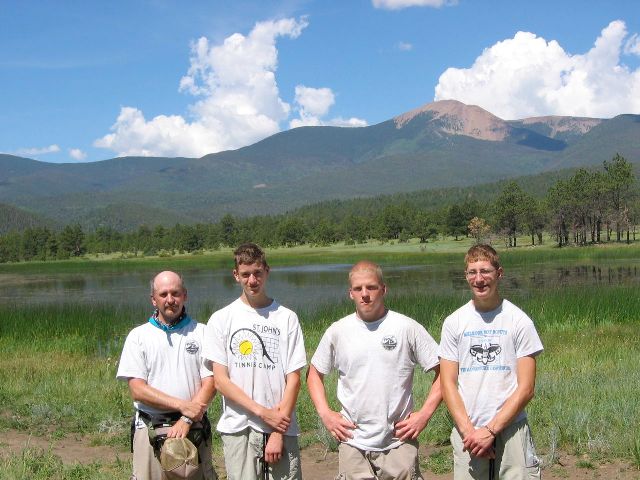
It is that time of year. Boys around the country will be joining Boy Scouting for the first time this month. And new parents will be asked to help their troop by becoming an adult leader. There are many reasons not to be a leader, but let me give you ten reasons why you should become a Scouter. (These are not in any sort of order.)

1) Be a positive influence in a boy’s life. I think we can agree that there are many youth out there who can benefit from more of this in today’s world.

2) Learn new skills. You are never too old to learn a new skill. And to tell the truth, I don’t think a person can ever learn too many skills.

3) Teach boys new skills. There are few things in life that will make you feel more proud then when you watch a boy or young man using a skill that you have helped them to master.

4) Make new friends. Not only will you form friendships with the boys, but you will also form new friendships with other Scouters.

5) Help your community. You provide this service through your unit’s service projects and by helping boys grow up to be better adults.

6) Spend time in the Great Outdoors. You really do need to get out of that recycled-air, stressed-filled office environment at least once a month.

7) Have a good laugh. Working with Scout age boys can be fun and funny in many ways. Just remember to laugh with the boys, not at the boys.

8) Go traveling. There are thousands of places to go that provide a great Scout Outing. And do not forget the opportunities to go to a National Jamboree, Philmont, or the other high adventure bases.

9) Get some exercise. We could all use more exercise. Just try keeping up with a group of Boy Scouts.

10) Be a kid again! Scouting gives adults the chance to have just as much fun as the Scouts themselves. Make sure that you do!

Well, those are ten of my reasons for being an adult Scout Leader. I am sure that some of you reading this could add some more to the list. I invite you to leave a comment and add those reasons.

scoutmastergeorge1(This is the second of a two part post.)

In September, 1981, it was time for a special troop committee meeting to decide what to do about the scoutmaster who was not doing his job satisfactory. The district executive had been invited to the meeting for his input and ideas. The meeting was held at a local restaurant. I attended but I had to leave early to go to the Cub Pack’s committee meeting. (I was planning to become the Webelos den leader.)Nothing had been decided by the troop committee before I left.

On the way home from the Cub Pack meeting I noticed that a couple of the troop committee members were still there chatting. I stopped in to find out what had been decided.I was surprised when they told me they had decided to dismiss the current scoutmaster. I did not realize at that time that that could be done, but they were told by the district executive that that was one option.

The second thing they told me surprised me even more.They had appointed me as the new scoutmaster! They had not even asked me! I had turned 21 two months earlier in July so I was now qualified.Well, I was not sure I was ready for this position, but I agreed to take it.I also had to call back the Cubmaster and tell him that I would not be able to take the Webelos den leader position.

I felt proud of myself to be a 21 year old scoutmaster.My ego was riding high until the Scouts found out about it.For some reason that I have yet to really determine, almost one third of the troop membership quit after I took the role.I tell you that brought the ego back down to where it needed to be pretty fast.

During the next years we worked hard to bring a quality program to the troop. The membership grew and the troop thrived.

Recently, troop membership is down due to difficulties that the Cub Pack has been having.I have been teasing the Boy Scouts that I would stay as scoutmaster at least until September, even if the troop roster continues to shrink. “Why September?” they ask. “Because then I will have my 25 years in as scoutmaster and I can retire”, I tell them with a smile on my face.

scoutmasterjohn1The first year of our nearly started troop went pretty well. We had a full committee, a scoutmaster, a couple of assistant scoutmasters, and a decent size group of Scouts, about 15-20. Our troop leaders had taken some training. We had done a few outings, including a council event at Camp Ripley National Guard Base, and a canoe trip down the river that runs through town. We even had a plan for the next few months. Yep, things were looking good.

Toward the end of 1980 our scoutmaster, John, gave his notice of resignation for the end of January, 1981. He was one of the few policemen our town had at the time and being the scoutmaster just was not working out very well with the hours he was putting in. We all understood his problem. Thus, the end of January arrived, and Troop 68 no longer had a scoutmaster. In other words, no one had stepped up to the plate yet.

I was only 20 years old when John resigned, so I could not be the scoutmaster. The other assistant scoutmasters did not want the job either. No member of the committee stepped forward. So, we went on without a scoutmaster. That is, until the council found out. The council made it clear that there would be a scoutmaster or they would pull our charter. Well, that got a little action. George, our committee chairman, decided to step down from his post and “temporarily” take the job as scoutmaster.

George was scoutmaster for only a couple months when the committee found someone they thought would be a great candidate for the job. A new chiropractor, Don, had moved into town, and he had earned the Eagle Scout rank as a Boy Scout. The troop signed him up as scoutmaster right away.

At first, things went well. But the Monday night meetings did not fit Don’s schedule well so he changed them to Tuesday nights. Unfortunately, that created problems with high school sports. As the month’s continued we began to see less and less of Don at troop functions. It finally got to the point were I, the assistant scoutmaster, was actually doing the work of scoutmaster. I will never forgot the night that Don invited me out to dinner to get an update on the troop because he had lost track of what was going on.

By this time, the committee was quite frustrated. They did not know what they could do about the situation so they called in the district executive for a special meeting.

(To be continued…..)

It was a beautiful evening in Melrose on that April day in 1980. A great day to get a few friends together, meet at the city park, and play some ball. I was nineteen years old, almost done with tech college, and was lucky enough to find a full time job, and a place to rent, in my hometown.

We had been playing ball for a little while when I noticed some young boys taking down a tent on the other side of the park. “Could that be a Boy Scout group?” I asked myself. There had not been a troop in town for at least 4 or 5 years. I had been a Boy Scout for a few years when I was in my mid teens and enjoyed it. I had thought about joining a troop as an adult leader after finishing college. Maybe this was my chance.

I walked over to the small group packing up the tent and talked to the adult leader, who also happened to be a policeman in town. He admitted that he was the scoutmaster of the newly formed troop. In fact, the troop was only a few months old. I asked if he needed any help? He was no idiot so he took me up on my offer. I became an assistant scoutmaster.

Little did I realize that I would still be involved with that troop 25 years later.

During the last 25 years I have seen a lot of boys come and go in Scouting. I have formed strong friendships with some of the boys that have continued into their adult lives. I have gone on many trips with the Scouts, including several trips to Philmont Scout Ranch. I have participated in many training sessions, have trained other leaders, and made many friends with other leaders.

With this blog I plan to write about some of my experiences and share some of the things I have noted and felt over those years. I invite your comments and would like to hear from you.

Steve B
Scoutmaster, Troop 68